
A Practical Guide to Understanding the Circular Economy
The circular economy aims to rethink the way we produce and consume in order to make better use of resources and reduce waste. Considered a key driver of the ecological transition, it promotes more sustainable practices and better conservation of natural resources.

To help the public better understand this field, the Office québécois de la langue française has published a glossary containing more than 120 key concepts. It includes terms such as the rebound effect, collaborative consumption, industrial symbiosis, open and closed loops, and the various types of resource recovery.
Produced in collaboration with several Quebec experts and organizations, this guide serves as a useful reference for anyone wishing to better understand the principles of the circular economy and familiarize themselves with the terminology of this rapidly evolving field.
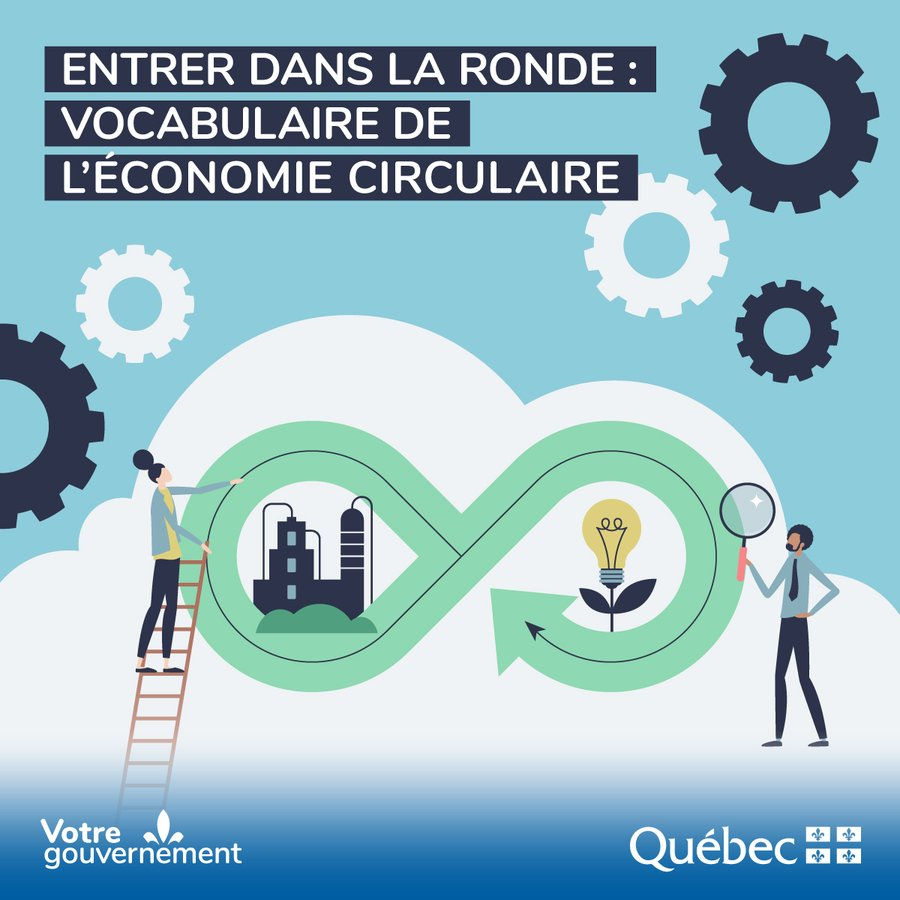
While this vocabulary represents a significant step forward in developing a common language, certain definitions—such as that of eco-design—nevertheless give rise to reflection and debate within the field.
Eco-design: What if we took it a step further?
In an article on the Vocabulary of the Circular Economy published by the Office québécois de la langue française, Christophe Abrassart* emphasizes the importance of developing a common language to support the transition to a circular economy. He does, however, call for a discussion of certain definitions, particularly that of eco-design.
According to him, by insisting that an eco-designed product must offer value equivalent to that of a conventional product, we risk limiting the process to a mere improvement of what already exists. Yet eco-design can also be used to imagine new ways of meeting needs, by challenging our habits, our practices, and even our value systems.
He also points out that setting aside the term “ecodesign” reflects a primarily technical view of eco-design, whereas designers make an essential contribution through their ability to envision desirable futures and explore new solutions.
In short, Christophe Abrassart advocates for a more open and ambitious conception of eco-design: an approach capable not only of reducing environmental impacts, but also of transforming the ways we think, produce, and live within the planet’s limits.
This post is inspired by an article by Christophe Abrassart on the definition of eco-design in the Office québécois de la langue française’s Vocabulary of the Circular Economy.
*Christophe Abrassart is a researcher and professor at the School of Design at the University of Montreal. He works in the fields of design and eco-design, with a particular interest in the connections between ecological transition, the circular economy, and design practices. His work focuses in particular on how design can help transform production and consumption systems, going beyond simply improving existing products. He is also interested in the cultural and social dimensions of design—that is, the ways in which words, tools, and practices influence how we envision environmental solutions.


Comments